

Desiccant Dehumidifier DBA-DD850
Desiccant Dehumidifier DBA-DD850
Request a quote
Mon–Fri 09:30–18:00 HKT
DBA-DD850
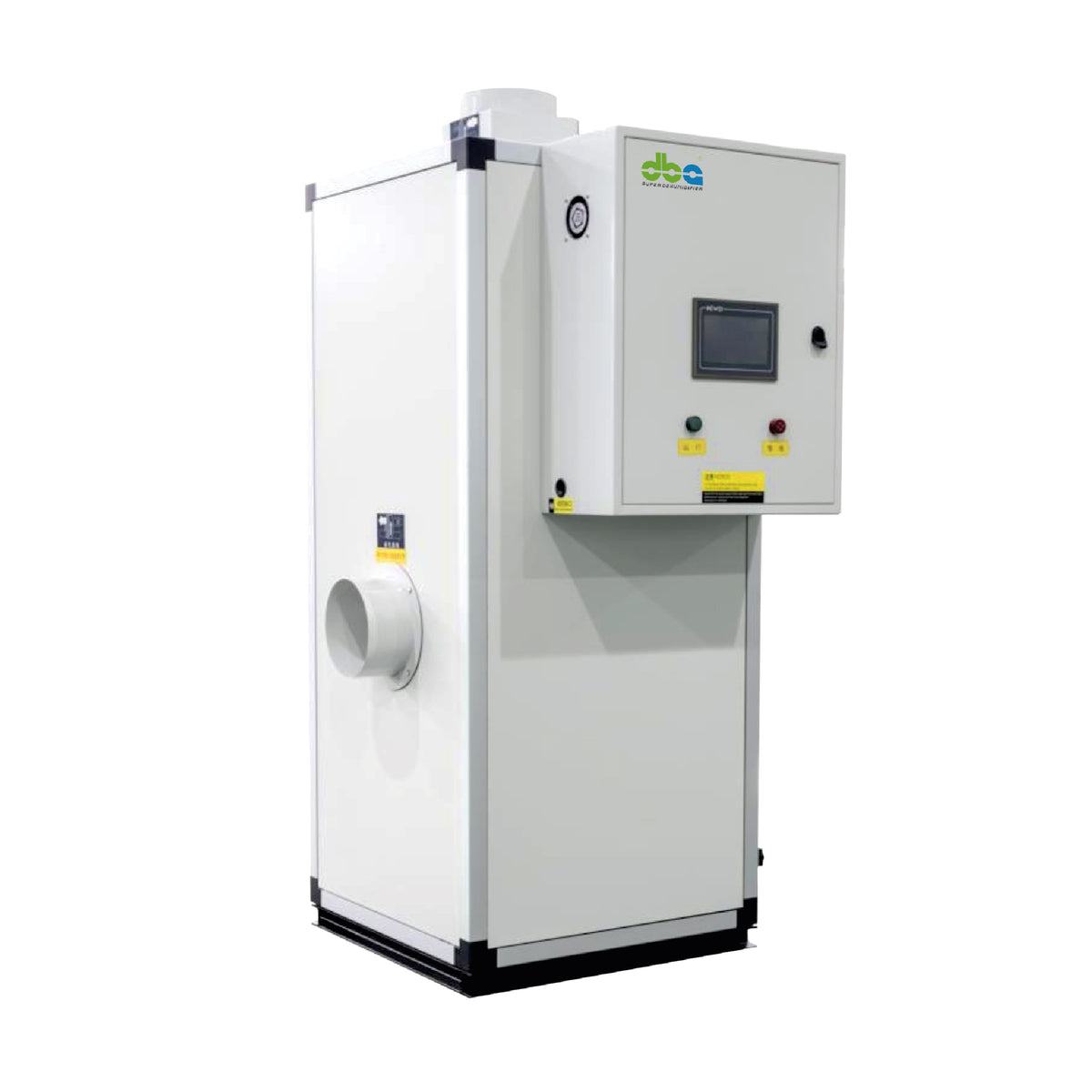
High-capacity three-phase desiccant dehumidifier. No compressor, no refrigerant — operates from −20°C to 40°C.

Still running when compressors freeze.
A silica-gel rotor absorbs moisture directly from the air. A PTC ceramic heater dries the wheel continuously as it turns — no cold coil, no refrigerant circuit to ice over.
Swedish ProFlute rotor.
The core desiccant component is rated for up to 10 years of continuous service.
Coil frosts below 5°C.
Relies on a refrigerant circuit. Extraction drops sharply in cold environments and stops entirely when the coil ices over.
Operates down to −20°C.
Desiccant rotor absorbs moisture at any temperature. No refrigerant required. Suited to cold stores, archives, laboratories and pharmaceutical warehouses.
Specifications
Configuration
Control
How much drying does your space need?


Desiccant Dehumidifier
Cold and very dry — where refrigerant units cannot go
Moisture is absorbed by a rotor rather than condensed by a compressor, so the unit works from -20°C to 40°C and controls humidity to ±1%.
Works in the cold Operating range from -20°C to 40°C.
A refrigerant dehumidifier condenses moisture on a cold coil. As the temperature drops the coil frosts, and extraction falls away sharply or stops altogether. A desiccant unit has no compressor — a moisture-absorbing rotor does the work instead, and it stays effective in the cold. Cold stores, chillers, low-temperature laboratories and winter site work are all within its range.
Drier than a refrigerant unit can reach Humidity can be taken far below the level an ordinary dehumidifier can hold.
A refrigerant unit becomes less efficient the drier the air gets, and eventually reaches a floor it cannot go below. A desiccant unit keeps pushing humidity lower, which is what makes it suitable for laboratories, data centres, lithium battery production, pharmaceutical packaging, optical lenses and precision assembly.
Swedish ProFlute rotor The core component is a Swedish ProFlute desiccant rotor.
One side of the rotor absorbs moisture from the process air while the other is regenerated by a PTC ceramic heater, which carries the moisture away and exhausts it outside; the rotor turns continuously between the two. The rotor is the heart of the machine — the Swedish ProFlute rotor is efficient and durable, with a service life of up to 10 years.
±1% control, 7-inch screen, RS485 Modbus Humidity is controlled to ±1%, with a 7-inch display.
The 7-inch screen shows current humidity and operating status directly, and the unit controls to your target once set. Automatic fault diagnosis and a power-off memory function are included, so settings are retained after a power cut. RS485 Modbus allows integration with a building management system (BMS).

Portable Dehumidifier (LGR)
FOR PORTABLE, HIGH-EFFICIENCY DRYING
DBA LGR (low-grain refrigerant) technology removes moisture down to very low humidity levels, mounted on wheels for easy relocation. Suited to water-damage restoration, construction sites, and any space that needs powerful drying without a fixed install.

Industrial Dehumidifier
FOR LARGE-SCALE, CONTINUOUS DUTY
High-capacity three-phase units rated up to 550L per day with built-in pump drainage and coverage to 5,000 sq ft. Designed for warehouses, plant rooms, and industrial facilities running around the clock.

Humidity Control Unit
PRECISION HUMIDITY CONTROL, DEHUMIDIFY & HUMIDIFY
DBA Humidity Control Unit, both removes and adds moisture to keep humidity locked at your chosen level. Built for museums, laboratories, galleries, and data centres where conditions must stay exact.

Desiccant Dehumidifier
FOR HUMIDITY CONTROL IN LOW TEMPERATURE
Desiccant-wheel technology keeps extracting moisture in cold and near-freezing conditions, where refrigerant units lose performance. Suited to cold storage, pharmaceutical plants, storage rooms, and low-temperature processing areas.
DBA Commercial Dehumidifier
-

Ultra Thin Ceiling Dehumidifiers
Save space with DBA's ultra thin ceiling dehumidifier — 20cm slim, auto...
-

Fresh Air Dehumidifier (Ceiling Mounted)
DBA fresh air ceiling-mounted dehumidifier is designed to not only remove excess...
-

Desiccant Dehumidifier
Desiccant dehumidifier uses a desiccant wheel (without a compressor), it is effective...


